
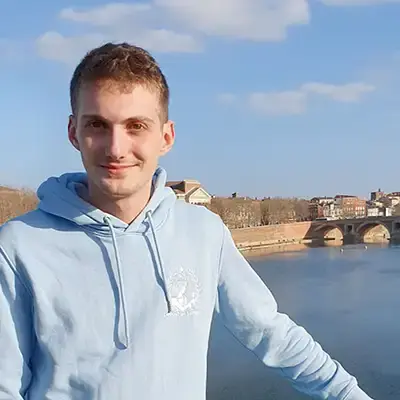
In 2024, Onaïa Savary is a fourth-year student at the École Normale Supérieure in the Department of Teaching and Research (DER) in Civil and Environmental Engineering.
ENS Paris-Saclay allowed me to develop my scientific skills and knowledge, and then the time came to decide what I wanted to do with them. I’ve always felt a strong connection to the issues surrounding climate change. I constantly wondered what I could do, on my own small scale, to help solve this problem that affects us all a little more every day. Using my scientific skills to embark on a dissertation in climatology seems like a first step to me, and I hope to do my part.
What is your educational background?
After earning a scientific baccalaureate with a specialization in Computer Science, I attended a PTSI/PT preparatory program in Toulouse. I then gained admission to the ENS through the competitive entrance exam, where I entered the Saphire program. The Saphire year really helped me figure out what interested me in the sciences related to engineering. Coming from PTSI, I already had an idea of what was involved in mechanical engineering. Since electrical engineering didn’t interest me at all, I wanted to explore the field of civil engineering. So, after completing the Saphire program, I enrolled in the civil engineering department for the MAISE Master’s program (M1).
This master’s program is of excellent quality and gave me a fairly broad overview of what’s involved in civil engineering. Before that, I thought of civil engineering as being a bit like the construction industry, with cranes and excavators plowing through concrete. I realized—and it was a pleasant surprise—that this description was far from reality. I came to understand that research in civil engineering often focuses on the strength of materials under specific stresses, such as the failure modes of a building during an earthquake. In fact, I completed my research internship at the EESD laboratory at EPFL (in Switzerland), where I worked on issues related to seismic resistance.
I then enrolled in the Master 2 in Higher Education Training (M2FESUP). I felt that what was missing from the ENS curriculum compared to engineering schools was essentially communication courses. Studying civil engineering through the lens of pedagogy allowed me to simultaneously expand my knowledge and my teaching skills. Since both my parents work in the public school system, I grew up in the world of education, and I was eager to explore it a little further. On top of that, the faculty advisors for the M2FESUP program are excellent educators, and I enrolled with complete confidence, knowing that the teaching team was of the highest caliber.
I am currently pursuing a Master 2 in Fluid Mechanics, a joint program between the Sorbonne and Polytechnique. I discovered fluid mechanics (which has nothing to do with what we do in preparatory classes) in the M2FESUP program, and I wanted to complement my very “materials-focused” background with a research-oriented master’s in fluid mechanics. I think I can say that this year has really won me over, because I’m going to continue with an internship and then a thesis in the field of climatology.
Did you know from the start what you wanted to do when you entered ENS Paris-Saclay?
Not at all! That’s precisely what’s interesting about the ENS Paris-Saclay degree: coming from an engineering prep program, you enter the Saphire year, where you can really explore a very broad range of subjects over the course of a semester. And the degree program is truly flexible, so you can really pursue what you love. A huge advantage of the ENS is that there are as many academic paths as there are students, and the faculty (in civil engineering, at least) are truly attentive and available to offer guidance.
My own path actually reflects quite well the fact that I wasn’t quite sure what I wanted to do when I entered the ENS. I was accepted to Centrale Supélec and the ENS, and I chose to attend the ENS Paris-Saclay because I knew I’d find greater intellectual stimulation there. I was really able to discover what was happening in the fields of research, teaching, and, at the same time, engineering. This broad perspective at ENS allowed me to define more precisely what I wanted to do afterward.
Which specific program did you take? How did you find out about it? What does it involve?
So I took the M2FESUP program offered by the DGCE. When I entered the ENS, for the reasons mentioned above, I was immediately drawn to this specific program. However, I was really worried about whether I had the necessary academic level to successfully complete the program, especially since I wasn’t among the top students in my SAPHIRE class.
During this year, we cover a broad range of topics in civil engineering. The idea is that we delve deeply into certain subfields of civil engineering, and the basic-level tutorials are drawn from the agrégation exams. In this way, we simultaneously earn a Master’s 2 degree with a very strong foundation in civil engineering and arrive highly prepared for the agrégation exams. Civil Engineering has excellent results in terms of the M2FESUP program, with nearly 100% of students obtaining the agrégation, and the majority of these École Normale students ranking at the top of their class.
During my internships, I realized that the level of research and scientific openness fostered by ENS Paris-Saclay is largely on par with that of the top schools. On the other hand, I was able to get involved in student life as vice president of the Student Union (BDE) and as an elected member of the Student Council (CA) and the Student Representative Council (CVE). Although I was worried that the Saclay campus might lack a vibrant student life, my involvement in student organizations allowed me to meet quite a few people and take a break from my studies.
Can you tell us what the School offers you?
I’m still happy to be able to keep racking my brain over scientific problems and to keep learning new things. In that regard, the ENS is really interesting and has allowed me to develop my research skills. Discovering a phenomenon, asking myself what the scientific explanation behind it might be, and being able to independently conduct an investigation to answer the various questions that arise… These are all skills I’ve learned to develop at the ENS.
During my internships, I realized that the level of research and scientific open-mindedness fostered by the ENS is on par with that of the top schools.
On the other hand, I was able to get involved in student organizations as vice president of the Student Union (BDE) and as an elected member of the Student Council (CA) and the Student Representative Council (CVE). Although the Saclay campus made me worry there wouldn’t be much of a student life, getting involved in student organizations allowed me to meet quite a few people and take a break from my studies.
What are your plans for the future?
I’ll be doing an internship followed by my thesis at Météo France (in the Large-Scale Meteorology and Climate Group) to study the impact of climate change on our ability to predict extreme weather events, such as droughts.
ENS Paris-Saclay helped me develop my scientific skills and knowledge, and then the time came to decide what I wanted to do with them. I’ve always felt concerned about the issues related to climate change. I constantly wondered what I could do, on my own scale, to help solve this problem that affects us all a little more every day. Using my scientific skills to embark on a Ph.D. in climatology seems like a first step to me, and I hope to do my part.