
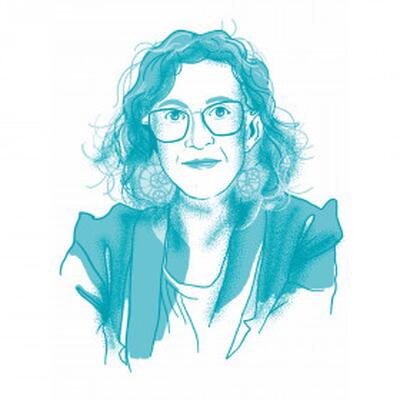
In my field, mechanics, and even more so in the environment where I work at the Ministry of the Armed Forces, personality plays a major role. I don’t think there’s necessarily a gender issue; rather, it’s a one-size-fits-all model of operation that needs to be reexamined. A model where careers are expected to follow a linear path with predetermined milestones, and where colleagues are expected to conform to a certain mindset. Diversity is what fuels creativity—whether we’re talking about personality, gender, field of study, background, or nationality!
Activities
I am an Associate Professor at the Saint-Cyr Coëtquidan Military Academy (AMSCC), which means I teach mechanics to Army officer candidates enrolled in an engineering program and also conduct research. I began my career at Gustave Eiffel University, and after three years, I requested a secondment to the Ministry of the Armed Forces to continue in the same role but at the AMSCC in Brittany.
For the past year, I have been the director of the engineering sciences research division at the AMSCC’s research center, the CReC. This research center is the Army’s only research center and brings together faculty members and researchers from various disciplines in engineering sciences as well as the humanities and social sciences. It’s a very enriching work environment, but we lack the critical mass to conduct cutting-edge research in each of our fields.
I am therefore also an associate researcher at the Dupuy de Lôme Research Institute in Lorient, a laboratory dedicated to mechanics that brings together about a hundred faculty members and researchers. I conduct my research in collaboration with colleagues from this laboratory as well as from other laboratories in France, such as the LMPS (Paris Saclay), and internationally, such as at the University of Minnesota and Cornell.
My specialty is the study of instability phenomena and structured materials. I try to model their behavior mathematically to better understand and predict it. We often work in research teams where each member, with their own specialty, contributes valuable knowledge and skills to the research question we are addressing. Teamwork is also a key part of teaching. In fact, at the university and in engineering schools, there is no national curriculum, so it is the faculty members and tenured professors who design the curriculum based on educational objectives and the students’ future careers.
It is always very rewarding to share opinions and knowledge within a teaching or research team. But to ensure we’re heading in the right direction, it’s essential to have a diversity of perspectives. This is what is made possible by diverse, international recruitment that brings together people from different backgrounds. Diversity is what fuels creativity—whether we’re talking about personality, gender, discipline, background, or nationality!
Your experience as a woman
As a woman in a field where we’re in the minority: you have to learn to say “No .”
As a young researcher, I’m asked to serve on panels, committees, and at conferences more frequently than my older male colleagues. I recently found myself on a thesis committee where the members implied that I wasn’t there because of my qualifications. Never again!
When you’re starting out as a faculty member, the demands are overwhelming, and it’s normal to feel overwhelmed. You have to review articles for peer review, serve on thesis committees and selection committees, present your work at conferences, respond to calls for proposals… For a woman in fields like mechanical engineering—where we’re in the minority—the demands are even greater, largely due to the gender parity quotas that were recently implemented. Driven by my enthusiasm and my desire to do well, I accepted every request I received, to the point where I often found myself with entire months filled with meetings, thesis committees, and all kinds of other committees—at the expense of my research. While talking with my colleagues, I realized there was a disparity between the requests I received and those received by my male colleagues. Then, recently, I was invited to serve on a thesis committee, during which it became clear that my presence was due to a quota… This experience, as unpleasant as it was, taught me to say “no.” I also have the right to have time to do research rather than rushing all over France to meet a quota… and to my great surprise, the colleagues whose invitations I decline take it very well: what a relief!
Career Path
- 2007–2010 Department of Civil Engineering – ENS Cachan
- 2010–2013 Ph.D. in Civil Engineering – UPMC and EDF R&D
- 2013–2015 Postdoctoral Fellow in Mechanics – University of Minnesota (USA) and École Polytechnique
- 2015–2017 Research Engineer at Safran Tech
- 2017–2020 Assistant Professor of Mechanics and Civil Engineering – Université Paris-Est Marne-la-Vallée
- Since 2020 Associate Professor on secondment to the Ministry of the Armed Forces – Saint-Cyr Coëtquidan Military Academy
Facts and Figures
- Since 2022 Director of the Engineering Sciences Research Division for the Army at the Saint-Cyr Research Center-Cyr Coëtquidan
- 2 years on the National Committee of the CNRS, Section 9
- 4 participations in ANR projects
- 9 thesis advisories (completed or in progress)
- 14 international-level publications
- 21 international conferences
- 18 months at U.S. universities
- 2009 Secretary of the “Nuit aNormale” and Head of SeKsi
Illustration credits: Jérôme Foubert